Cheap Capital, Scarce Labour: Canada's AI Productivity Moment
Manny Bahia · November 10, 2026 · 7 min read

In my last piece, I argued that AI is the cheapest capital Canada has ever been offered. Last Thursday, Ottawa doubled down on that bet. Budget 2026 confirmed the Productivity Mega Deduction and stacked more money on top of it for AI adoption.
The same day, the government tabled its new Immigration Levels Plan. By Friday, the headline was a shocking 622,000 permanent residents in 2027. That's well above the 2024 peak of 485,000.
The question: If Canada is about to bring in record numbers again, doesn't that undo everything the budget is trying to do to increase GDP per capita?
It's a fair question. Two pieces ago, I called it the cheap-labour trap. When labour is abundant and cheap, firms hire instead of invest. Canada ran that experiment from 2022 to 2024, and capital per worker shrank.
We can't do that this time. But there's a narrower risk hiding inside that 622,000.
What the budget actually bought
Budget 2026 carries $142.1 billion in new measures over five years and a $62.3 billion deficit for 2026–27. The deficit hurts, for sure. But the direction is encouraging: make capital cheap, and guide it to AI.
Six measures matter for adoption:
- The Mega Deduction, confirmed: permanent 100% first-year write-offs for about two-thirds of business capital, including computers, network gear and purchased software.
- SR&ED for commercialization: the credit now reaches regulatory approvals, certifications and protecting IP that comes out of R&D. That's $930 million over five years.
- AI for All: a $2.7 billion national strategy with a target of 60% business adoption by 2034, up from 12% in 2025.
- Compute and financing: the AI Compute Access Fund grows to $1 billion, and BDC gets $500 million to finance SME adoption.
- Regional AI Initiative: another $500 million, with the next intake closing November 24.
- Canada Growth Incentive: a capital gains exemption of up to $15 million per founder on qualifying shares issued from November 5, 2026.
Also, Canada is set to have the lowest effective tax rate on new investment in the G7, by a wide margin.
The budget did its job. The question is on the labour market.
The 622,000 headline
This is the number everyone is fighting about.
The official permanent resident target is flat at 380,000 a year through 2029. The 2027 range tops out at 422,000. On top of that sits a one-time measure to grant PR to up to 200,000 people already in Canada. Add the top of the range to the one-time measure and you get 622,000.
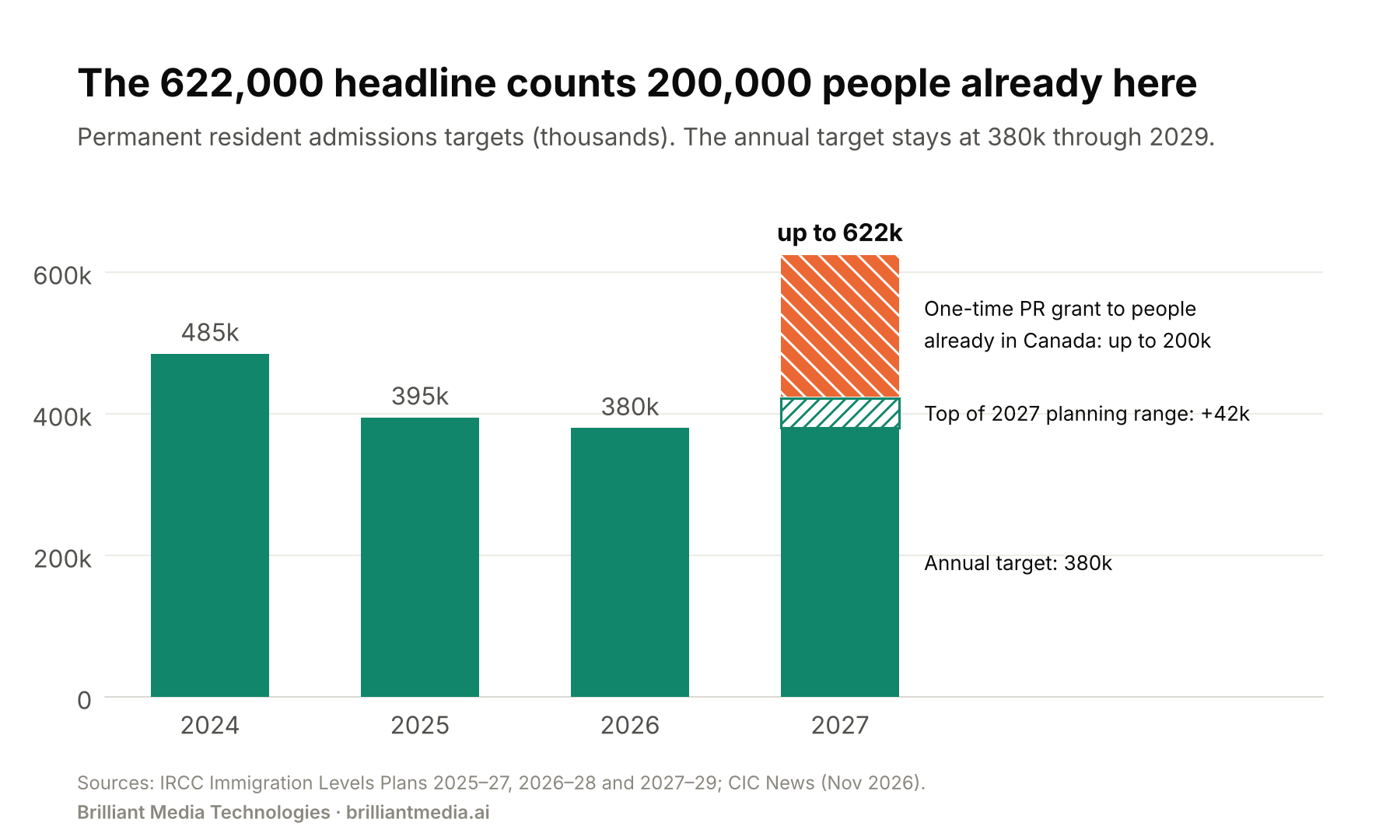
Pierre Poilievre accused the government of cooking the books by leading with 380,000. The Prime Minister's answer was that these are people who have been here for years, in workplaces that renew their permits every year.
Both things are true. The PR number in 2027 really could be the biggest we've seen. And most of those 200,000 are already here.
That second part is what matters for productivity. A PR card doesn't add a worker. It changes the paperwork for one who's already on the job.
Now look at what's actually happening to headcount:
- New temporary arrivals: cut from a target of 673,650 in 2025 to 385,000 in 2026, then 370,000 a year.
- Temporary residents in Canada: down 154,614 in the year to July 1, 2026, to 2.78 million. That’s the largest annual drop on record.
- Total population: up just 189,425, or 0.5%, in the year to July 1, 2026. That’s the slowest growth since the Second World War.
In 2023, population grew nearly 3%. That was the influx.
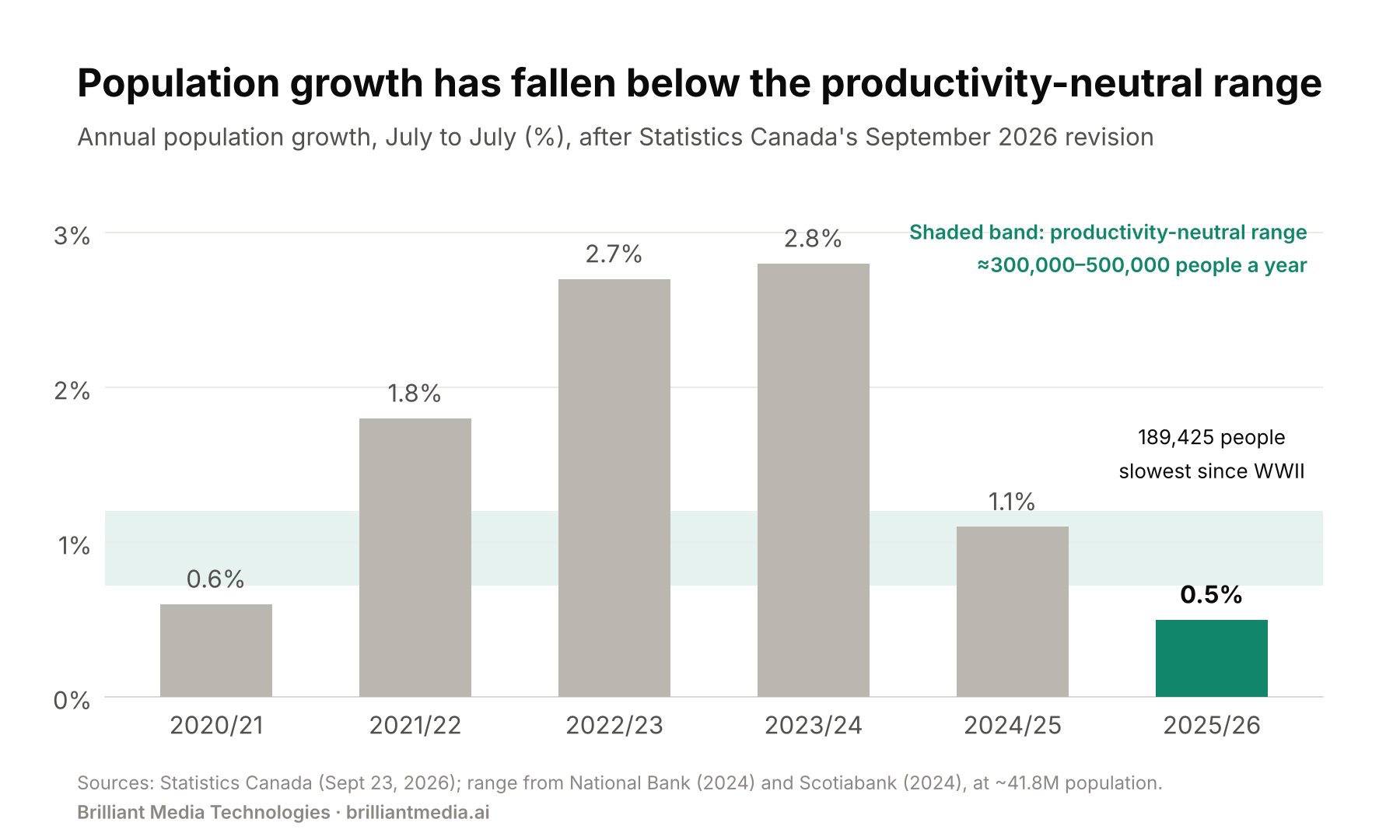
A note on the numbers. In June, Statistics Canada’s preliminary estimates showed the population actually shrinking. In September, it revised them up by about 301,000 people, mostly temporary residents waiting on permit extensions it hadn’t counted. The decline was a miscount. The slowdown is real.
One caveat: some of those 200,000 would have left when their permits ran out. Keeping them does make the population larger than it would otherwise be. But the percentage of the 200,000 that stays remains to be seen.
Cheap capital, scarce labour
Here's the part the immigration debate keeps missing. Firms don't choose between workers and machines in the abstract. They compare prices.
Ethan Lewis found that U.S. manufacturing plants in cities with bigger inflows of less-skilled immigrants bought noticeably less automation equipment (Quarterly Journal of Economics, 2011). When the U.S. ended the bracero farm-worker program in 1964, farm wages didn't rise much. Farms mechanised instead, and crops with no machine ready to go simply shrank (Clemens, Lewis and Postel, American Economic Review, 2018).
Cheap labour delays automation. Scarce labour speeds it up.
Canadian economists put numbers on the threshold. In 2024, National Bank's Stéfane Marion warned that Canada was in a "population trap" and that growth should stay between 300,000 and 500,000 people a year. Scotiabank put the productivity-neutral pace near 350,000.
Canada added about 189,000 people in the year to July 2026. That's below both.
So the budget lowers the price of capital, and the levels plan, for now, raises the price of labour. Both push the same way.
You can already see it in the data. In the Bank of Canada's latest Business Outlook Survey, investment intentions stayed robust while hiring plans stayed soft. Firms are planning to grow output without growing headcount.
That's the productivity story we've been waiting a decade to see.
Where I'd actually worry
It's four things underneath the headline number.
- Who the 200,000 are: by the government's own description, many are in workplaces that renew temporary permits every year. Those are the low-wage, labour-intensive businesses where AI adoption is lowest. Agriculture sits at 4.5%. Locking that labour in place removes the exact cost pressure that would have pushed those firms to automate. PR status lets workers move to better jobs, which pushes wages up over time. We need to watch which sectors these transitions land in.
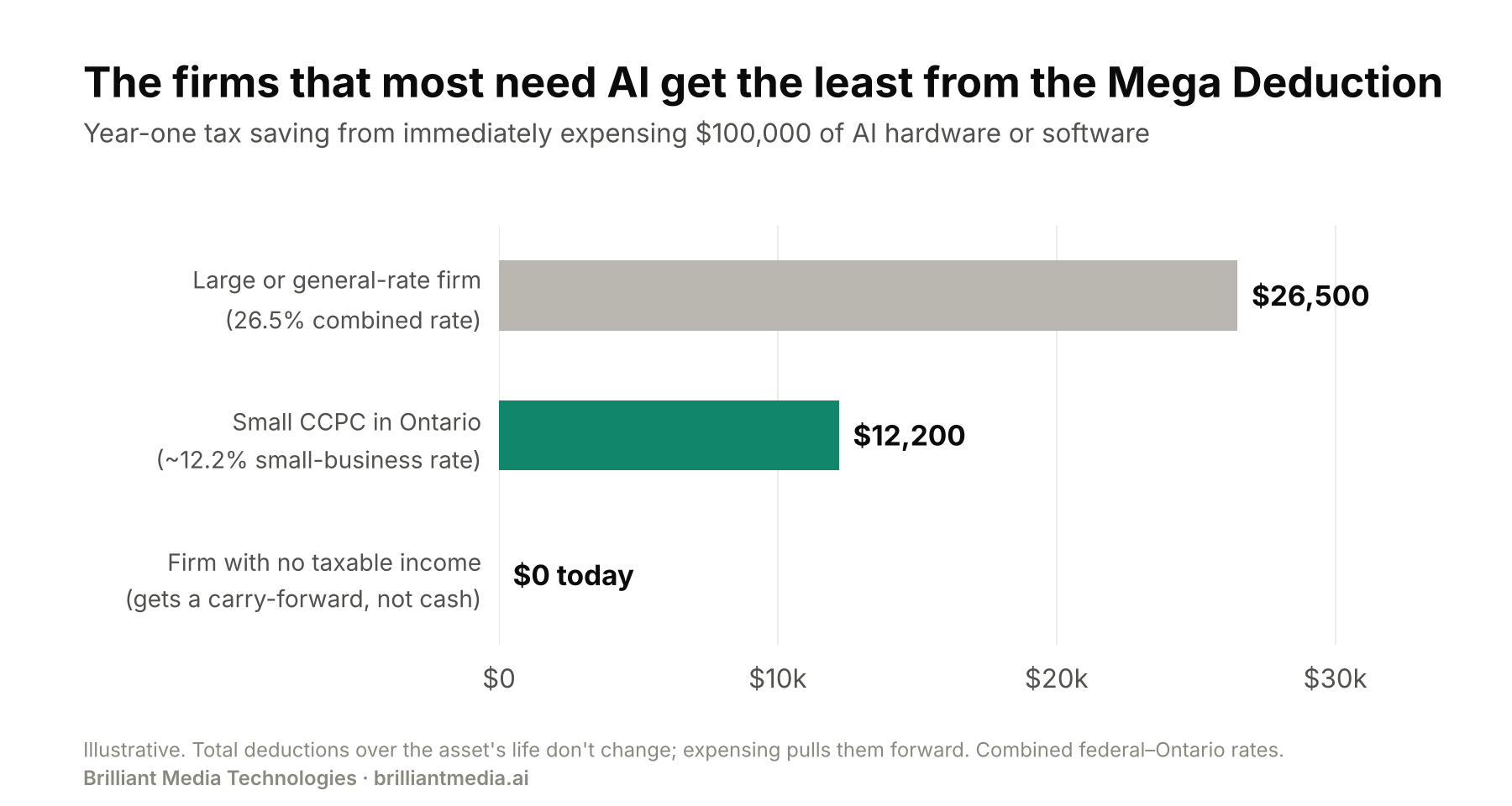
- The small business rate: a dollar expensed early is worth about 12 cents to a small Canadian-controlled private corporation, against 26.5 cents at the general rate. A firm losing money gets nothing today. U.S. evidence backs this up: firms in tax-loss positions barely responded to bonus depreciation. The firms that most need AI are the ones the deduction helps least. (See chart below).
- It isn't law yet: the Mega Deduction is still draft legislation. TD's economists note that it relies on businesses having the confidence to invest. Tariffs aren't helping with that.
- Skills, not bodies: the Bank of Canada says the shortages that bind are in skilled trades and specialized technical roles. Here, immigration is part of the fix. About two-thirds of PR admissions are economic class, and Canada's AI sector runs on immigrant talent. Cut the wrong immigrants and you starve the very adoption the budget is paying for.
None of this means population doesn't matter. Lower immigration also means an older country, and GDP per capita counts retirees too. But the answer to an ageing population is more output per worker. That's the whole argument for AI.
Three asks
- To policymakers: pass the Mega Deduction before spring, and publish who's in the 200,000 by sector. Then give small and loss-making firms a version they can actually use, like a credit instead of a deduction.
- To business owners: stop waiting for cheap labour to come back. It isn't coming. Price your next hire against an AI deployment, and if you're eligible, get your Regional AI Initiative application in by November 24.
- To ourselves at Brilliant Media Technologies: train builders where the shortage actually is, in the sectors losing temporary labour fastest. And keep publishing real results.
The number that matters
For a decade, Canada made labour cheap and capital expensive. We got exactly what that buys: more workers, less capital each, and a falling standard of living.
For the first time in a long time, both prices are moving the right way at once.
The number that matters isn't 622,000. It's capital per worker. And right now, Canada has its best shot in a generation at moving it.
Sources
- Department of Finance Canada, Budget 2026: Key measures, November 5, 2026.
- Department of Finance Canada, Government of Canada introduces new Productivity Mega Deduction, September 15, 2026.
- Innovation, Science and Economic Development Canada, Canada's National AI Strategy: AI for All, 2026.
- FedDev Ontario, Government of Canada expands support for AI adoption and commercialization in southern Ontario, October 2026.
- CIC News, Canada announces plans for up to 622,000 new permanent residents in 2027, November 2026.
- The Canadian Press via CP24, Poilievre accuses government of cooking books on immigration, November 6, 2026.
- Statistics Canada, The Daily: Canada’s population estimates, second quarter 2026, September 23, 2026.
- The Hub, StatsCan reports slowest population growth since Second World War as immigration cuts take hold, September 25, 2026.
- RBC Economics, Revised numbers point to positive population growth in Canada, September 2026.
- Ethan Lewis, Immigration, Skill Mix, and Capital Skill Complementarity, Quarterly Journal of Economics, 2011.
- Michael Clemens, Ethan Lewis and Hannah Postel, Immigration Restrictions as Active Labor Market Policy, American Economic Review, 2018 (NBER summary).
- Stéfane Marion and Kyle Ducharme, Canada's population trap, National Bank Financial, January 2024.
- Scotiabank Economics, Canada's immigration policy, March 21, 2024.
- Bank of Canada, Business Outlook Survey — Third Quarter of 2026, October 2026.
- Eric Zwick and James Mahon, Tax Policy and Heterogeneous Investment Behavior, American Economic Review, 2017 (NBER working paper).
- TD Economics, Canada's Productivity Mega Deduction, 2026.