The fall of Canada's productivity
Manny Bahia · September 29, 2026 · 8 min read
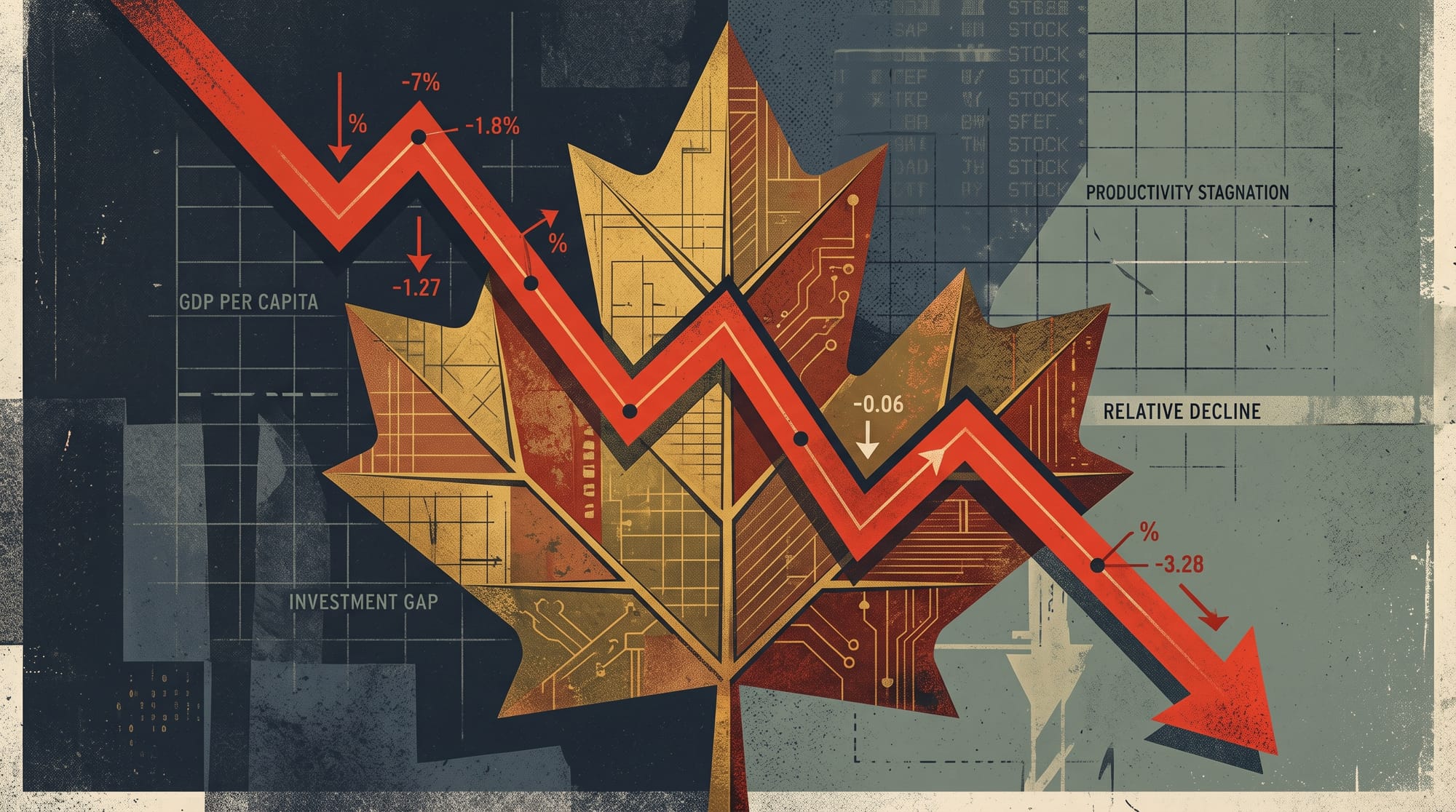
Earlier this year, one comparison hit a nerve across the country. The Globe and Mail reported that Canada's GDP per capita had fallen behind Alabama's, and the reaction was immediate: a wave of criticism of GDP per capita itself, questioning whether it measures national prosperity at all.
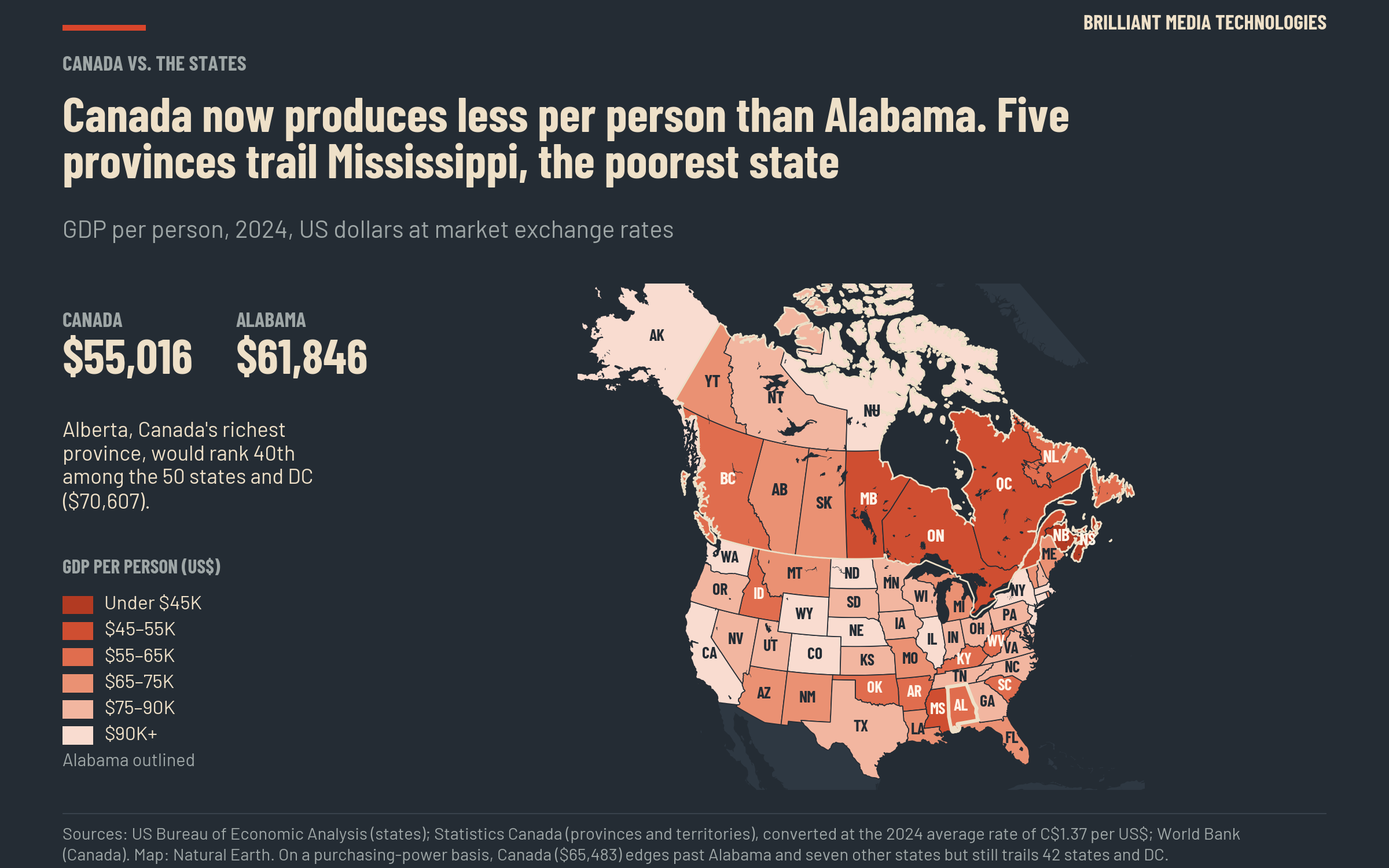
That tells you a lot about how this country handles bad news. Faced with evidence that Canadians are getting poorer relative to our peers, a large part of the commentariat decided the real problem was the metric.
I've watched this number for years. A couple of years before GDP per capita became a headline, I sat down with a Member of Parliament and said plainly that I was worried about where it was heading. The concern was acknowledged but set aside. Instead, I was pointed to a different number: the poverty rate, which was falling, and which I was told was the metric that really mattered.
I didn't buy it then, and I don't now. The poverty rate, as it was calculated at the time, had two problems. First, it was falling largely because government transfers were rising, funded by spending the country could not sustain long after the emergency had passed, not because Canadians were earning more. Second, the poverty line was measured against a basket of living costs data that was lagging behind what Canadians were actually paying for housing, just as rents and home prices were skyrocketing.
The data since has made the point for me. Median government transfers to Canadian families roughly doubled in the first year of the pandemic, from $8,500 in 2019 to $17,000 in 2020, measured in 2021 dollars. The official poverty rate fell to 7.4% by 2021. Then the benefits wound down, and by 2023 the rate was back at 10.2%, statistically no different from where it stood before the pandemic. After an unprecedented spending spree, the needle was right back where it started.
A falling poverty rate can tell you a government is redistributing more of the pie. It can't tell you whether the pie is growing, and in the long run a growing pie is the only thing that pays for redistribution. That exchange stayed with me because it captured the whole problem of politics in one conversation. When the number you should be watching isn't great, spin a better-looking one.
The number, and the sleight of hand
GDP per capita is simple: take everything the country produces in a year, adjust for inflation, and divide by the population. It's the average person's share of the economy.
The division is where the trick hides. Total GDP can grow while GDP per capita shrinks. If the economy grows 2% and the population grows 3%, you can hold a press conference about growth while every household gets poorer.
That's roughly what happened. RBC's economists found that per-person GDP fell steadily through 2023 and 2024 while the headline figure overstated how healthy the economy was. Canada added people far faster than it added the capital, housing and infrastructure to support them, and the aggregate number made that look like success. Anyone in government who cited headline GDP during those years without the per-capita figure next to it was likely hoping you weren't paying attention.
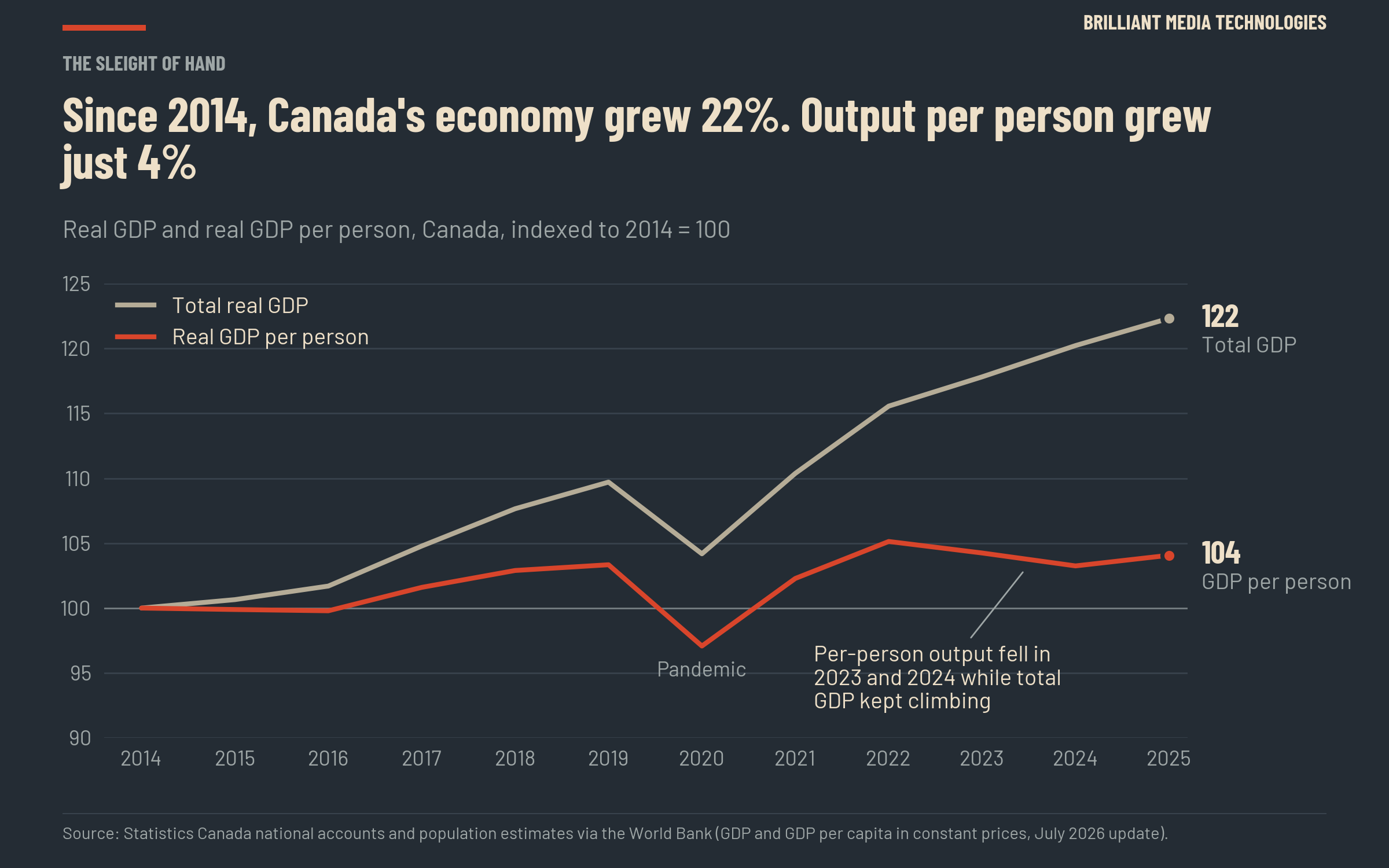
The longer view is worse. A 2025 study by Lawrence Schembri, a former Deputy Governor of the Bank of Canada, and Milagros Palacios found that real GDP per person fell 2.0% between 2020 and 2024, the worst five-year stretch since the Great Depression, while the overall economy kept growing. Blame the pandemic if you like, but nearly every other G7 country, along with Australia and New Zealand, climbed back to or above its pre-pandemic level. Canada didn't. A growing economy in which the average person gets poorer is almost unheard of among advanced economies.
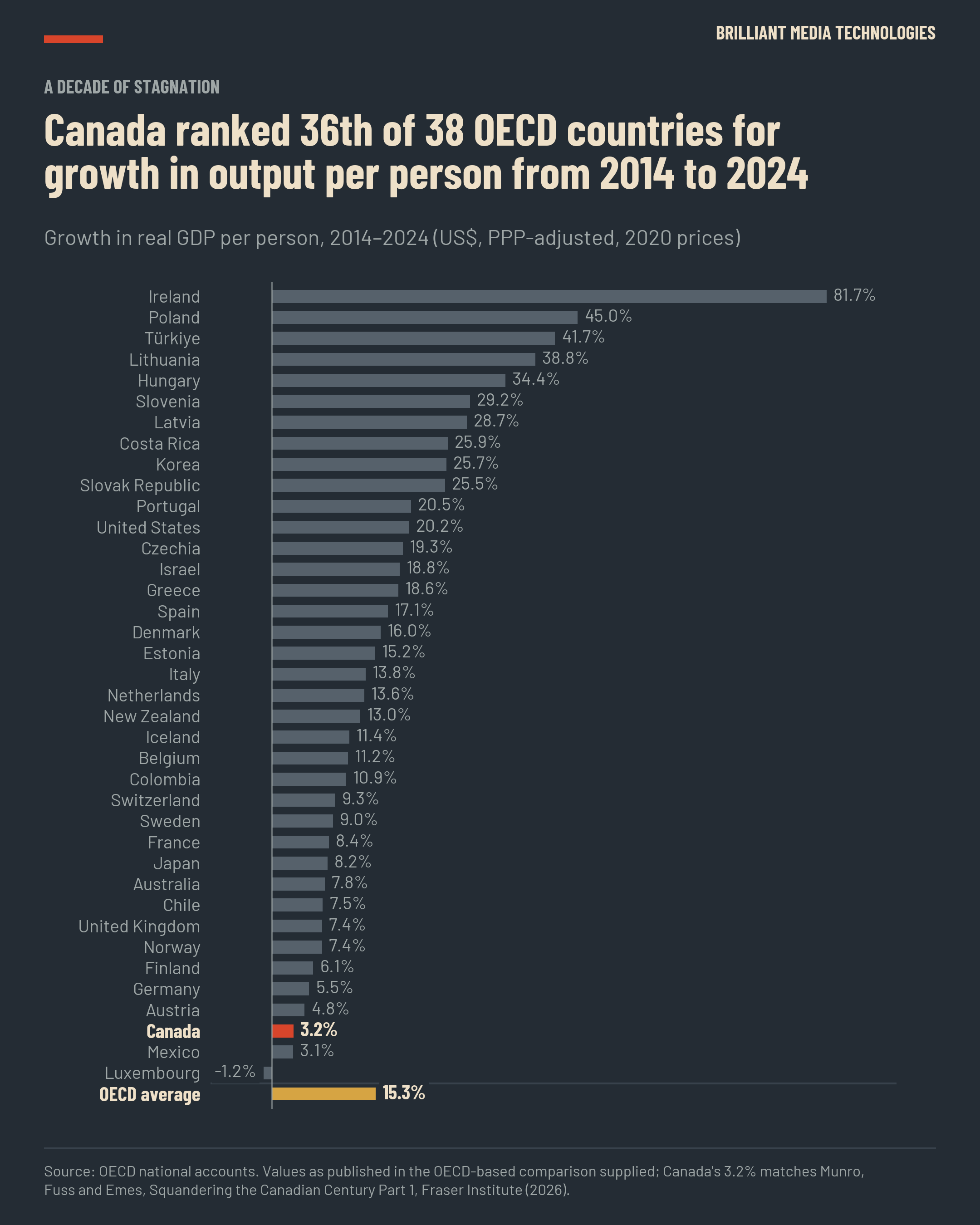
And it isn't just the pandemic years, or just the G7. Over the full decade from 2014 to 2024, Canada's output per person grew 3.2%. The OECD average was 15.3%. The United States managed 20.2%. Out of 38 OECD countries, Canada finished 36th, ahead of only Mexico and Luxembourg.
Why the number matters
GDP per capita isn't a measure of happiness or virtue. It measures something more basic: how much a society has to work with.
Simon Kuznets, the economist who built modern national income accounting, warned in the 1930s that it shouldn't be read as a measure of a nation's welfare. He was right. But over time, wages can't outrun output per worker. When each worker produces more, employers can pay more without raising prices. When they don't, raises are an illusion that inflation takes back.
This isn't abstract. In 2024, the typical Canadian worker earned less, after inflation, than the typical American worker earned in 2010. Fourteen years behind, and the gap is still widening.
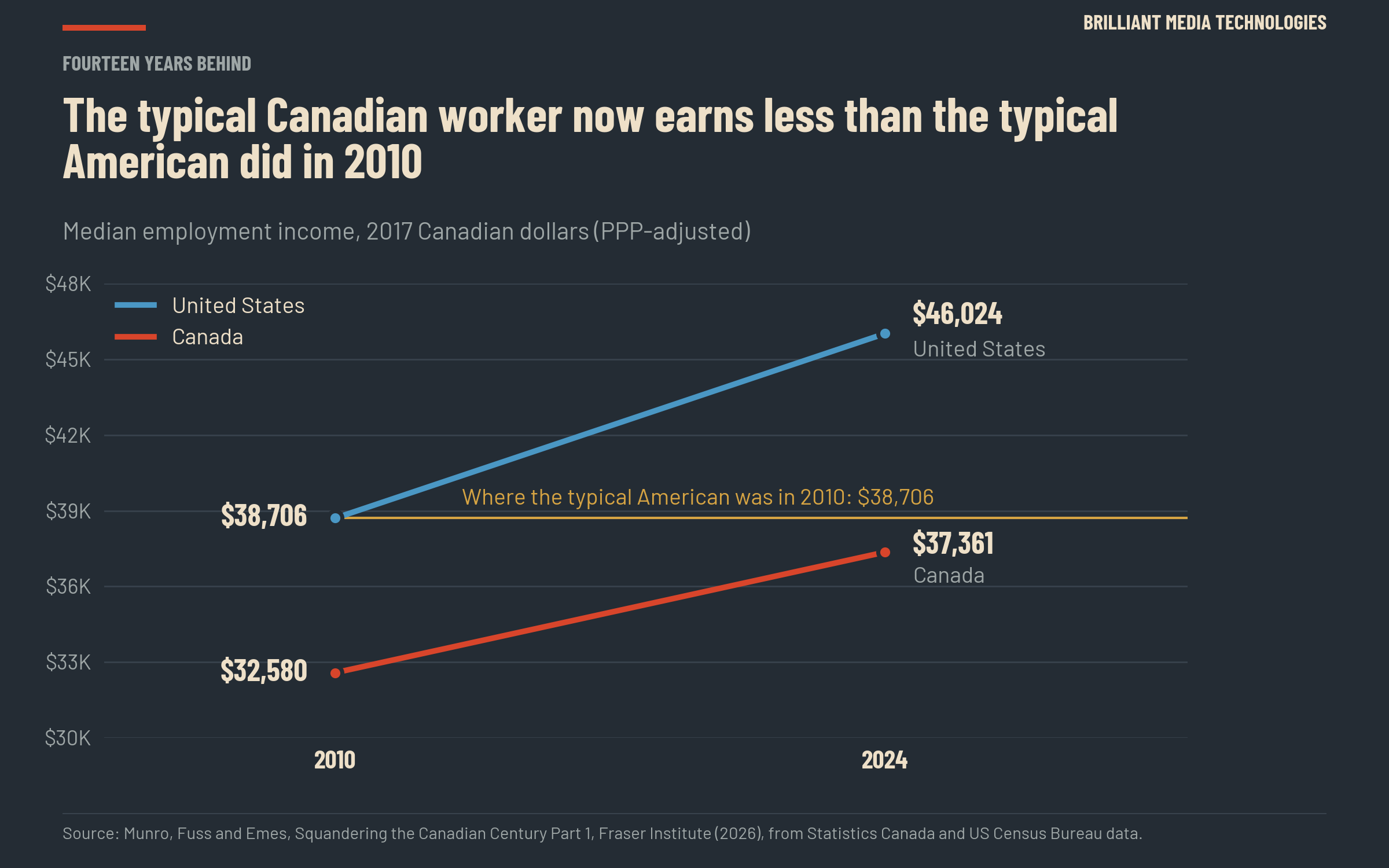
Every public service Canadians care about — health care, pensions, housing support, defence — is paid for out of what the economy produces per person. When that stalls, you get exactly the debates we're having now: higher taxes, more debt, longer waits, and a generation that no longer believes it will do better than its parents.
The Bank of Canada understood this. In March 2024, Senior Deputy Governor Carolyn Rogers called weak productivity an emergency and said it was time to "break the glass." It's worth asking how urgently we have responded to this "emergency."
The critics are half right
The case against GDP per capita isn't stupid, and I won't pretend it is.
It ignores distribution: a country where the top 1% captures every gain can post excellent numbers while most people fall behind. It misses unpaid work, counts disaster rebuilding as growth, and depends on exchange-rate adjustments economists argue about constantly.
All true, and all irrelevant to the question at hand. Those flaws apply to every country, so the real question is whether Canada's trend relative to its peers signals a deeper problem.
What's striking is who reaches for these objections. People who spent a decade citing GDP growth, or a falling poverty rate, as proof that their policies worked discovered the limitations of measurement at exactly the moment the per-capita numbers turned against them. That's not intellectual honesty.
Every instrument says the same thing
If you don't trust GDP, look at the measures designed to capture what it misses.
Canada fell from 13th to 16th on the UN Human Development Index between 2013 and 2023. On the World Happiness Report, we've dropped from 5th in 2012 to 18th in 2025 and to 25th in 2026. Canadians under 25 now rank 71st in the world on happiness, against 24th for everyone else.
Read that last figure again. Our young people are among the least satisfied in the developed world, and they're the ones who will carry the debt, pay the rents and fund the pensions. They aren't confused about the economy. They've read it correctly.
The gap with the United States tells the same story. In 1999, the average American's share of the economy was worth about $10,800 more than the average Canadian's. By 2024, that gap had more than doubled to nearly $23,800. For fifteen years, Canada held its ground at roughly 82 to 83 cents of American output per person. After 2014, it fell to 71.5 cents in a decade. That didn't happen in one bad year. It took a long run of decisions.
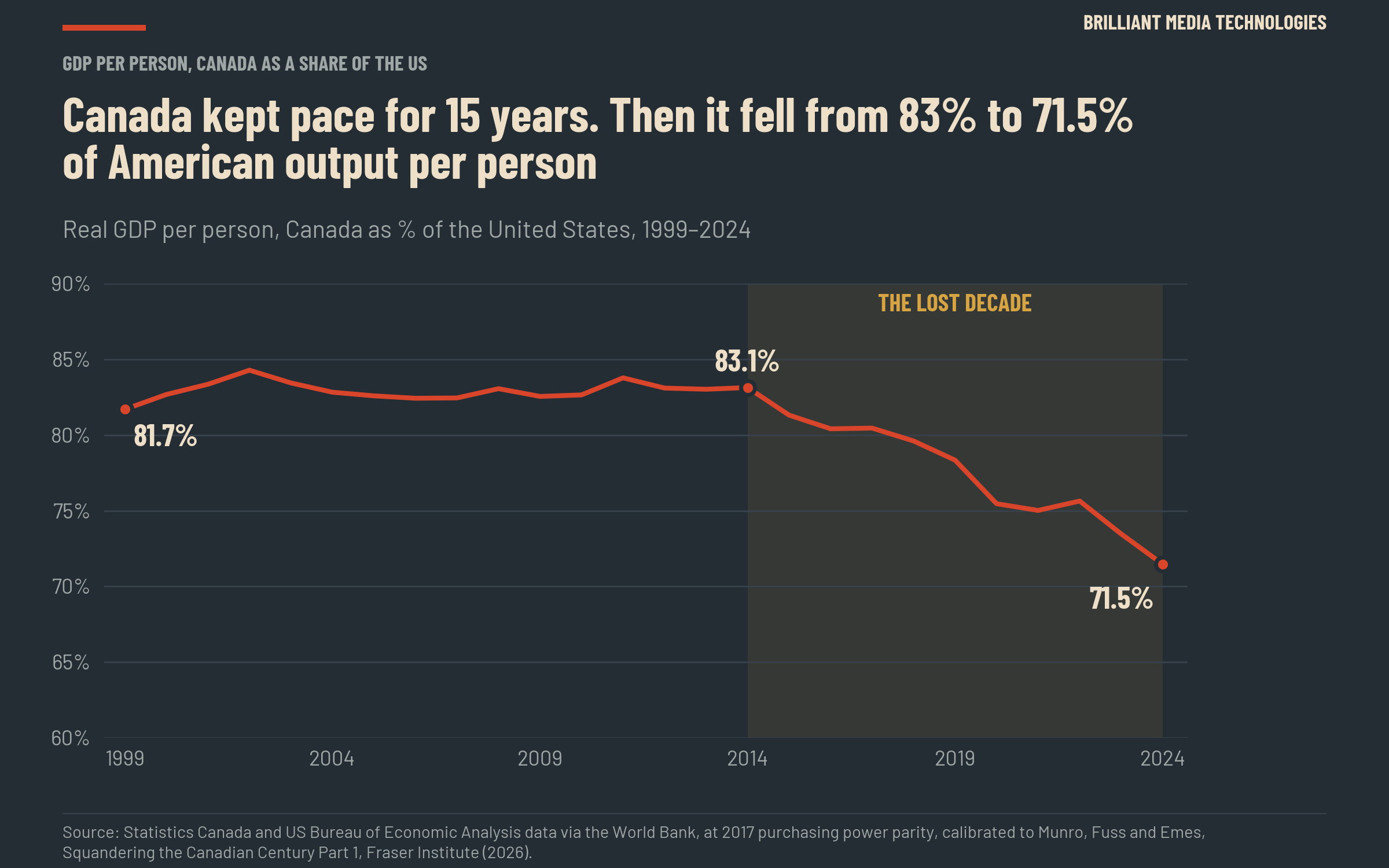
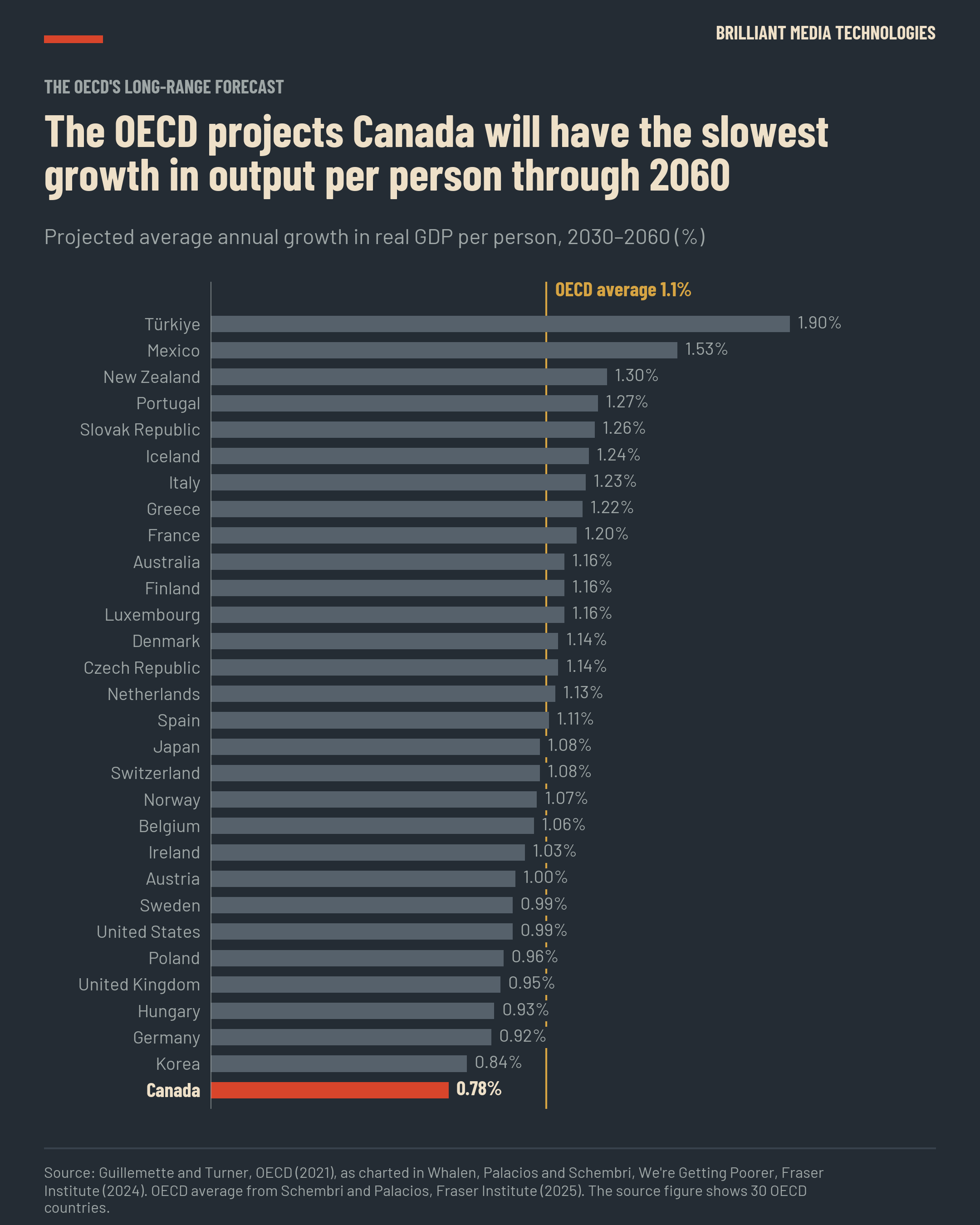
Sadly, even the pessimists were too optimistic. In 2021, the OECD projected that Canada would have the slowest growth in GDP per capita of all 38 member countries through 2060. Canada's actual performance from 2020 to 2024 came in below even that.
The forecast itself is worth seeing. The OECD's long-range projections put Canada dead last: 0.78% a year in output-per-person growth from 2030 to 2060, against an OECD average of about 1.1%. That gap sounds small until it compounds. Over three decades, it means Canadians' output per person grows about 26% while the average OECD country's grows about 39%.
Watch for the next sleight of hand
GDP per capita is about to start looking better, and that should make you more suspicious, not less.
In the first quarter of 2026, Canada's real GDP didn't grow at all, yet real GDP per capita rose 0.2%, because the population shrank for a second consecutive quarter. Output didn't rise. The denominator fell.
Expect to hear that as good news.
It's like a company boasting that revenue per employee went up after layoffs. It didn't sell a single thing more.
The only real fix is raising what each Canadian produces: better tools, more investment, better-run firms, and technology that makes an hour of Canadian work worth more than it was last year. There's no shortcut and no way to redefine the problem out of existence.
Why I keep pushing this
I've spent my career building companies in this country, first in digital media and now in applied AI. I don't raise this because the numbers make good content. I raise it because I think it's the most important economic problem Canada has, and because nearly every other crisis we argue about — housing, health care, the despair of young Canadians — is downstream of it.
When I raised this with a Member of Parliament years ago, I wasn't predicting anything clever. The trend was visible to anyone who looked at the per-capita figure instead of the headline. What struck me was the response: not to look harder at the uncomfortable number, but to reach for a more comfortable one. It's a failure of will, reinforced by incentives that reward whoever has the best-looking metric this quarter.
GDP per capita is imperfect, but it's right. Canadians have been getting relatively poorer for the better part of a decade.
In 1904, Sir Wilfrid Laurier predicted that the twentieth century would belong to Canada. It didn't. At the turn of this century, the same hope was revived for the twenty-first. We're a quarter of the way in, and we really have our work cut out for us.
In the next article, I'll dive deeper on the why. Canada didn't just have a growth problem, it had an investment problem, and the business community needs to also confront the truth.
Sources
- The Globe and Mail, "Out of nowhere, Canada became poorer than Alabama"
- Whalen, Palacios and Schembri, We're Getting Poorer, Fraser Institute, 2024.
- Statistics Canada, "Canadian Income Survey, 2021", The Daily, May 2, 2023.
- Statistics Canada, "Canadian Income Survey, 2023", May 2025.
- RBC Economics, "Canada's per-capita economy still recovering", June 2026.
- Lawrence L. Schembri and Milagros Palacios, Canada's "Ugly" Growth Experience, 2020–2024, Fraser Institute, 2025.
- Simon Kuznets, National Income, 1929–1932, report to the US Senate, 1934.
- Grady Munro, Jake Fuss and Joel Emes, Squandering the Canadian Century Part 1, Fraser Institute, September 2026.
- Carolyn Rogers, "Time to Break the Glass: Fixing Canada's Productivity Problem", Bank of Canada, March 26, 2024.
- Statistics Canada, "Gross domestic product, income and expenditure, first quarter 2026", The Daily, May 29, 2026.
Stay Updated
Practical notes on AI for your business, straight to your inbox.