Canada has a major business investment problem
Manny Bahia · October 6, 2026 · 8 min read

In my last piece, I argued that GDP per capita is the right number to watch, and that it's telling us Canada has been getting relatively poorer for the better part of a decade. Now I'll explain why.
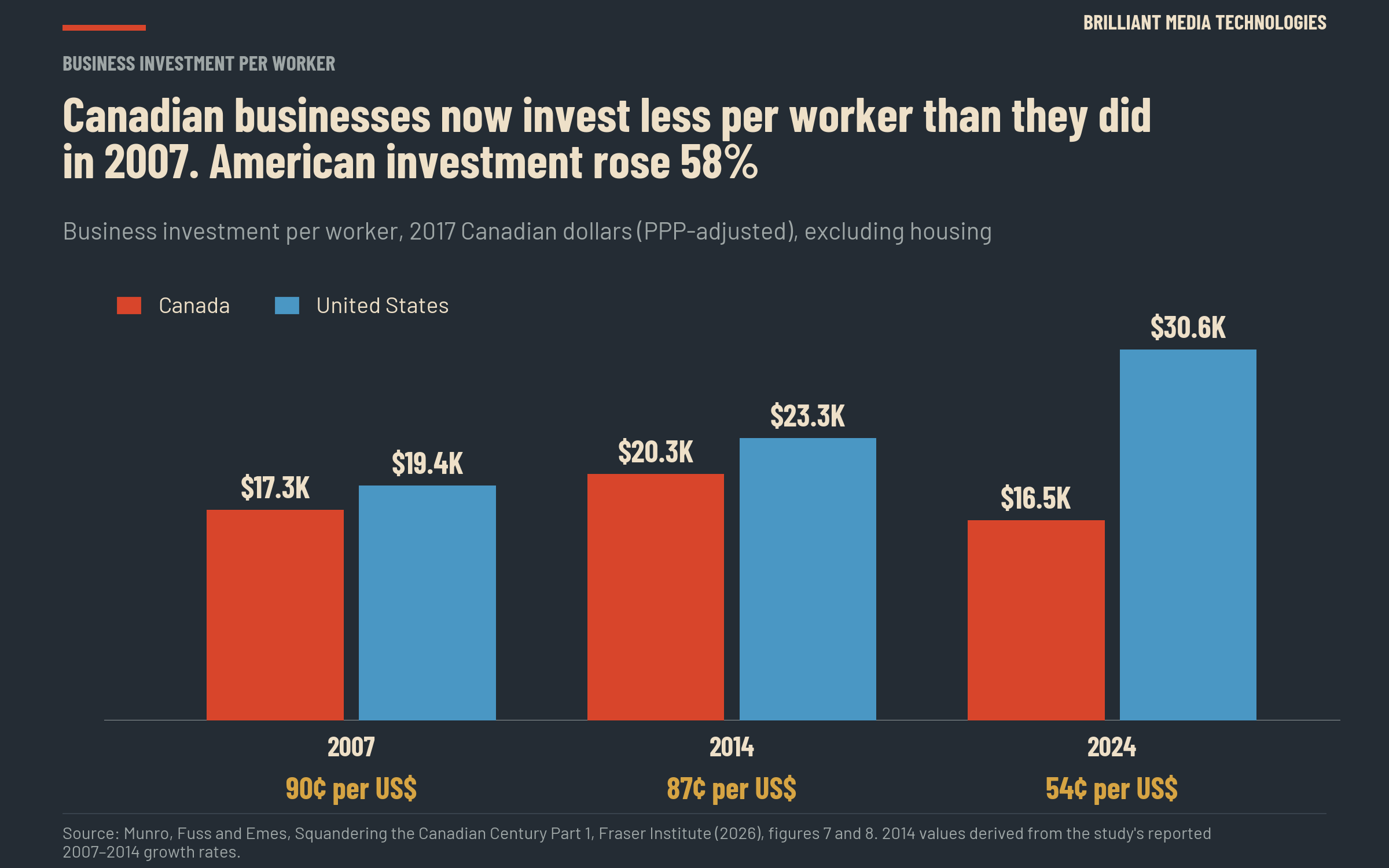
In 2007, Canadian businesses invested about $17,300 per worker in machinery, equipment, technology and intellectual property, adjusted for inflation. American businesses invested about $19,400. By 2024, the Canadian figure had fallen to about $16,500, nearly 5% lower than seventeen years earlier. The American figure had risen almost 58%, to more than $30,500. The gap between the two countries grew sevenfold.
Get this: the average Canadian worker today is equipped with less new capital than a Canadian worker was in the year the iPhone launched. Everything else in the productivity debate is downstream of that fact.
When the gap opened
This wasn't always Canada's story. From 2007 to 2014, Canadian investment per worker kept pace with the United States, holding at roughly 87 to 90 cents for every American dollar. Investment per worker grew 17.1% in Canada and 20.2% in the US over those seven years. Close enough.
Then it broke. In 2015, Canadian business investment per worker fell 12%, while American investment per worker grew. In 2016, Canada's fell almost 12% again. Over the following decade, it declined in five of ten years. American investment per worker declined in just one. By 2024, Canadian businesses were investing 54 cents per worker for every dollar invested south of the border, the lowest point on record in the study.
If that 2014 turning point looks familiar, it should. It's the same year Canada's GDP per capita stopped keeping pace with the United States, sliding from about 83% of the American level to 71.5% a decade later. That's where you see a cause and effect. Investment moves first. Living standards follow.
Productivity tells the same story. Between 1999 and 2025, output per hour worked grew nearly 68% in the United States and less than 27% in Canada. Sadly, Canadian labour productivity in 2025 was actually lower than it had been five years earlier.
Why investment is the whole game
Productivity isn't about working harder. It's about what each person has to work with: the equipment, software, systems and know-how that turn an hour of effort into more output. When businesses invest, workers get better tools, new technology gets built into the economy, and wages have room to rise. When they don't, none of that happens, no matter how hard people work.
The C.D. Howe Institute has tracked this for years. By its count, the average Canadian worker today has roughly 9% less capital to work with than a decade ago. In 2014, a Canadian worker was backed by about 89 cents of new capital for every dollar behind an American worker. OECD projections imply that this year it will be about 50 cents, half the new equipment.
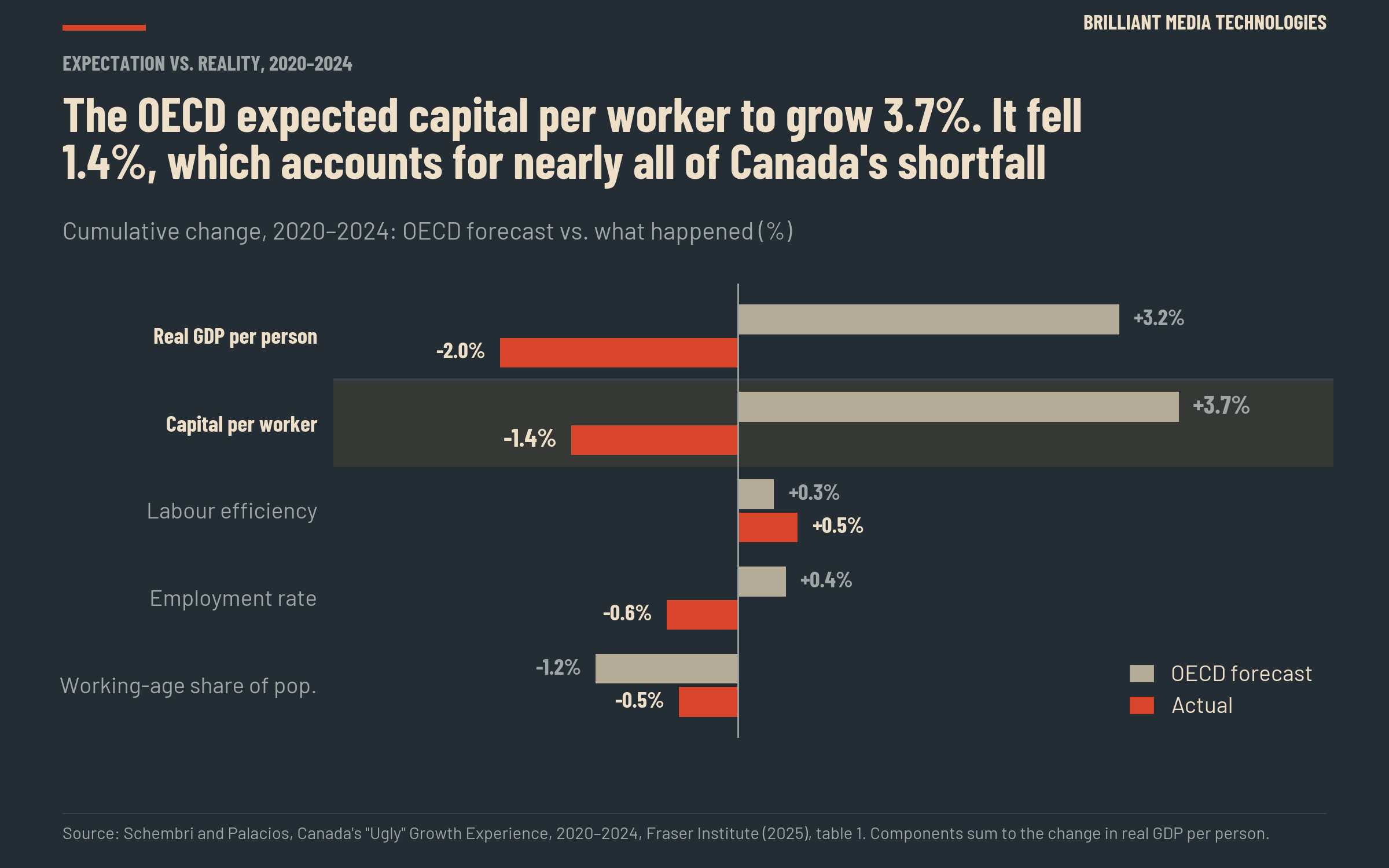
The pandemic years made it worse. A 2025 study by former Bank of Canada Deputy Governor Lawrence Schembri and Milagros Palacios broke Canada's 2020 to 2024 performance into its parts. The OECD had expected capital per worker to grow 3.7% over that period. It fell 1.4% instead. That one miss accounts for nearly all of the gap between the growth Canada was supposed to have and the decline it actually got. The gross capital stock grew just 7.1% in those five years, the weakest five-year stretch since 1961.
After accounting for equipment wearing out, new investment barely replaced what was being used up.
The cheap-labour trap
Over those same years, Canada made labour cheaper and capital more expensive, and businesses responded exactly as you'd expect.
On the labour side, employment grew faster than the capital stock, driven partly by a historic surge in temporary and permanent immigration. Real wages fell behind inflation for much of the period. Between 2020 and 2023, real median employment income fell 7.2% in Canada while it rose 6.9% in the United States.
On the capital side, roughly half of Canada's machinery and equipment is imported, and global shortages of chips, metals and energy drove its price up. Put those together and the incentive was obvious: hire another person rather than buy the machine or the software. Schembri and Palacios put it bluntly: firms had a strong incentive to substitute cheap labour for expensive capital, and productivity growth slowed dramatically as a result.
That is a rational choice for any single business. For the country, it's a slow disaster. Every firm that staffs up instead of upgrading, locks in lower output per worker, and lower output per worker eventually means lower wages for everyone.
Three comfortable excuses
Every time these numbers come up, someone reaches for an explanation that lets everyone off the hook. Three come up most often.
"It's oil." The 2014 oil price collapse was real, and so was the hostile climate for energy projects that followed. But the investment collapse didn't stay in the oil patch. It spread to utilities, retail, accommodation and food services, and beyond. A resource shock explains a bad year in Alberta, but it doesn't explain a decade of underinvestment across the whole country.
"It's the pandemic." The investment gap opened in 2015, five years before COVID. And after the pandemic, nearly every other G7 economy recovered its pre-pandemic GDP per capita. Canada didn't. The pandemic merely exposed the problem.
"It's immigration." Immigration policy genuinely made things worse. Adding millions of people in a few years, without the capital, housing or infrastructure to match, pushed capital per worker down further and gave businesses a reason to hire instead of invest. But the investment collapse began in 2015 and 2016, years before the 2022 to 2024 surge. Population growth certainly exacerbated the problem.
Who is actually responsible
It's tempting to put all of this on Ottawa, and Ottawa has earned a large share of it. Schembri and Palacios list the obstacles plainly: high corporate and personal taxes, restrictions on foreign investment, heavy and uncertain regulation, rising federal and provincial debt that signals higher taxes ahead, and interprovincial trade barriers that shield Canadian firms from competition. Add an immigration system that stepped away from selecting for skills in favour of filling low-wage vacancies.
Meanwhile, government employment in Canada has grown faster than private-sector employment since 1999. In the United States, it's been the reverse. Even the C.D. Howe Institute, not known for hyperbole, described the last decade of federal policy toward business investment as one of indifference.
The Bank of Canada's diagnosis goes further. When Carolyn Rogers called Canada's productivity problem an emergency, she pointed to a lack of competition as a root cause. Sheltered firms don't need to invest to survive.
But business doesn't get to sit this one out. Canadian companies made the investment decisions. They chose not to upgrade. And when labour got scarce after the pandemic, several of the country's most influential business associations, including the Canadian Federation of Independent Business, the Business Council of Canada and Canadian Manufacturers & Exporters, campaigned for more permanent and temporary immigration to fill the gaps. Faced with a choice between investing in productivity and lobbying for cheaper labour, much of corporate Canada chose the lobby.
That's the uncomfortable truth. Governments made capital expensive and labour cheap. Businesses took the deal. Workers paid for it in wages that stopped keeping pace.
What we stopped buying
The composition of the gap matters as much as its size. Research cited in the Fraser Institute's latest comparison finds that Canada fell furthest behind the United States in two categories: information and communications technology, and intellectual property. Software, data systems, digital infrastructure, research.
The very assets that drove the American productivity boom of the last decade are the ones Canadian firms bought least.
That's not a footnote. It means Canada's investment problem isn't mainly about pipelines or factories. It's about a business culture that treated technology as a cost to minimize rather than the main way to make each worker more valuable.
Is it finally turning?
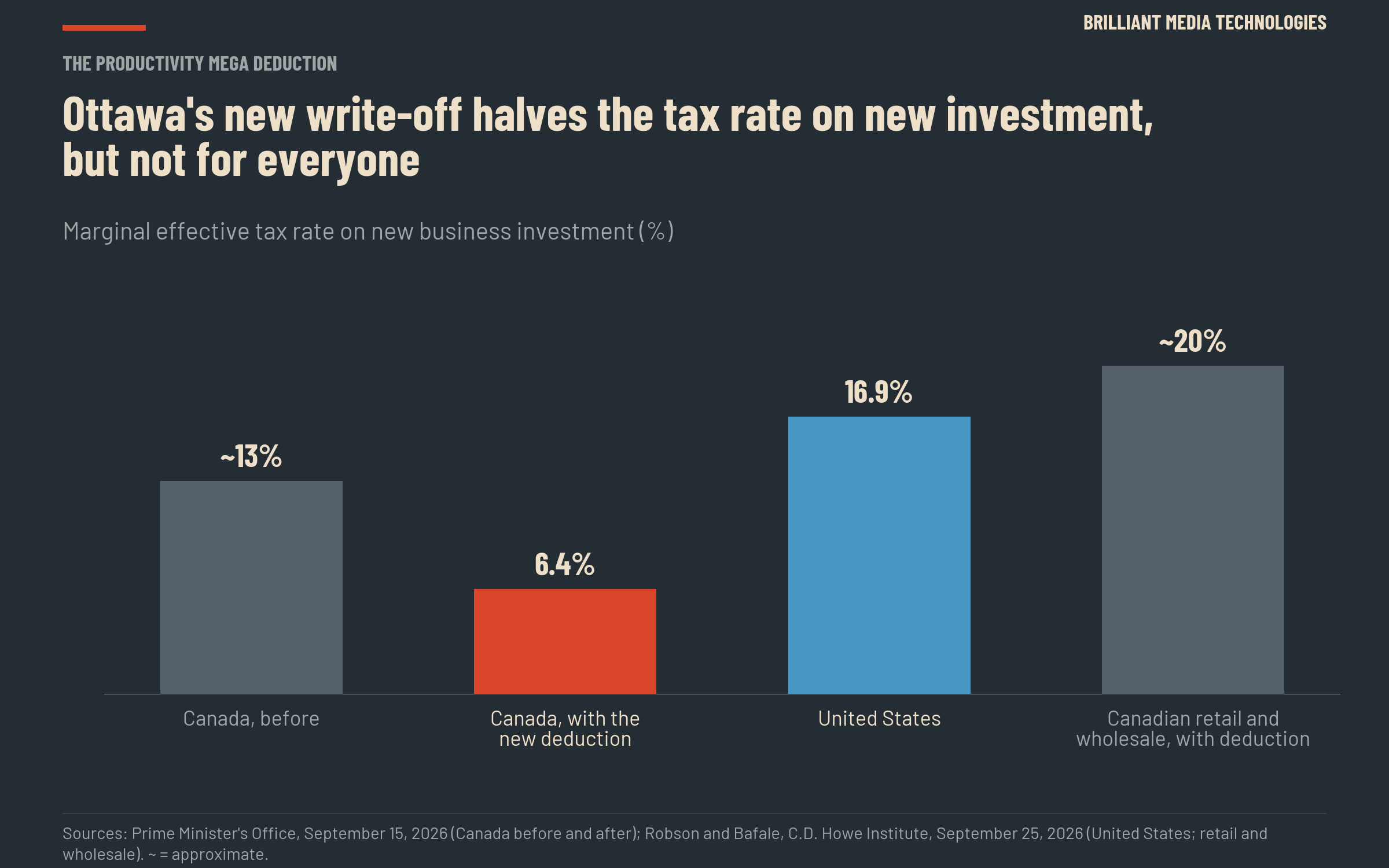
There are signs Ottawa has finally noticed. On September 15, at the first Canada Investment Summit in Toronto, Prime Minister Mark Carney announced a "productivity mega deduction" that lets businesses write off most new capital investment immediately, including software, computer equipment and R&D. By the government's own estimate, it cuts the effective tax rate on new business investment from roughly 13% to 6.4%. The C.D. Howe Institute puts the American rate at 16.9% and the cost at about $36 billion over five years. Add the cancelled capital gains tax increase, the promise to dismantle interprovincial trade barriers and lower immigration targets, and the direction has clearly changed.
Credit where it's due: this is the first federal government in a decade to put capital investment at the centre of its economic strategy.
But a tax break doesn't make anyone invest. The C.D. Howe analysis notes that the deduction helps capital-heavy sectors far more than others; in retail and wholesale trade, the effective rate stays close to 20%. It also leaves untouched the high personal and general corporate tax rates that push talent and capital south. And it takes time to build momentum and fill the current hole.
Most importantly, policy can only change incentives. The decisions still get made in boardrooms and by owners of the small and mid-sized firms that employ most Canadians. If they keep treating technology as optional, the deduction will subsidize investment that would have happened anyway, and the gap will stay open.
The opening
To be upfront, I run an applied AI company, so you'd expect me to say technology is the answer. Weigh my argument accordingly.
But the logic stands on its own. Canada's gap is a capital gap, and it's widest in exactly the category of capital that is now becoming dramatically cheaper and more powerful. For most of economic history, closing a capital gap meant building factories, buying heavy equipment and waiting years for the payback. A 20-person Canadian firm couldn't do that without a financing round.
That constraint is breaking. The most important productivity technology of this decade doesn't require a new plant. It can be deployed in weeks, costs a fraction of traditional capital, and works as well for a 20-person firm as for a bank.
Canada had an investment problem.
In the next article, I'll argue that we've just been handed the cheapest way to fix it that any country has ever had, and that the biggest risk is that we'll waste this chance the same way we wasted the last decade.
Sources
- Grady Munro, Jake Fuss and Joel Emes, Squandering the Canadian Century Part 1: Comparing Economic Performance in Canada and the United States, Fraser Institute, September 2026. The ICT and intellectual property finding comes from Steven Globerman's 2024 and 2025 Fraser studies cited there.
- William B.P. Robson and Mawakina Bafale, "Big Capital Deduction a Good Step, but Ottawa Needs to do More", C.D. Howe Institute, September 25, 2026.
- Lawrence L. Schembri and Milagros Palacios, Canada's "Ugly" Growth Experience, 2020–2024, Fraser Institute, 2025.
- Carolyn Rogers, "Time to Break the Glass: Fixing Canada's Productivity Problem", Bank of Canada, March 26, 2024.
- Prime Minister's Office, "Prime Minister Carney introduces new Productivity Mega Deduction", September 15, 2026.