The cheapest capital Canada has ever been offered
Manny Bahia · October 13, 2026 · 10 min read

In the first two articles in this series, I argued that GDP per capita is the right way to measure whether Canadians are getting better off, and that the reason we aren't is that Canadian businesses stopped investing in their workers. In 2024, American businesses invested about $30,500 per worker. Canadian businesses invested about $16,500.
That gap of roughly $14,000 per worker sounds manageable until you think about what closing it means. Canadian businesses would have to spend about 85% more on capital every year than they do now. Done the traditional way, that means new plants, heavy equipment and multi-year projects with long paybacks.
It isn't going to happen. Pretending otherwise is how we got a decade of productivity speeches with nothing to show for them.
So here's the question this article is about: what if the most important capital of this decade doesn't cost that much?
A different kind of capital
For most of economic history, raising productivity meant buying things that were big, expensive and slow. A factory line. A fleet. An enterprise software system that took two years and a consulting firm to install. That kind of capital has a minimum size. A large firm can afford it; a 20-person firm usually can't, and Canada's economy is disproportionately made of 20-person firms.
Artificial intelligence breaks that pattern in three ways.
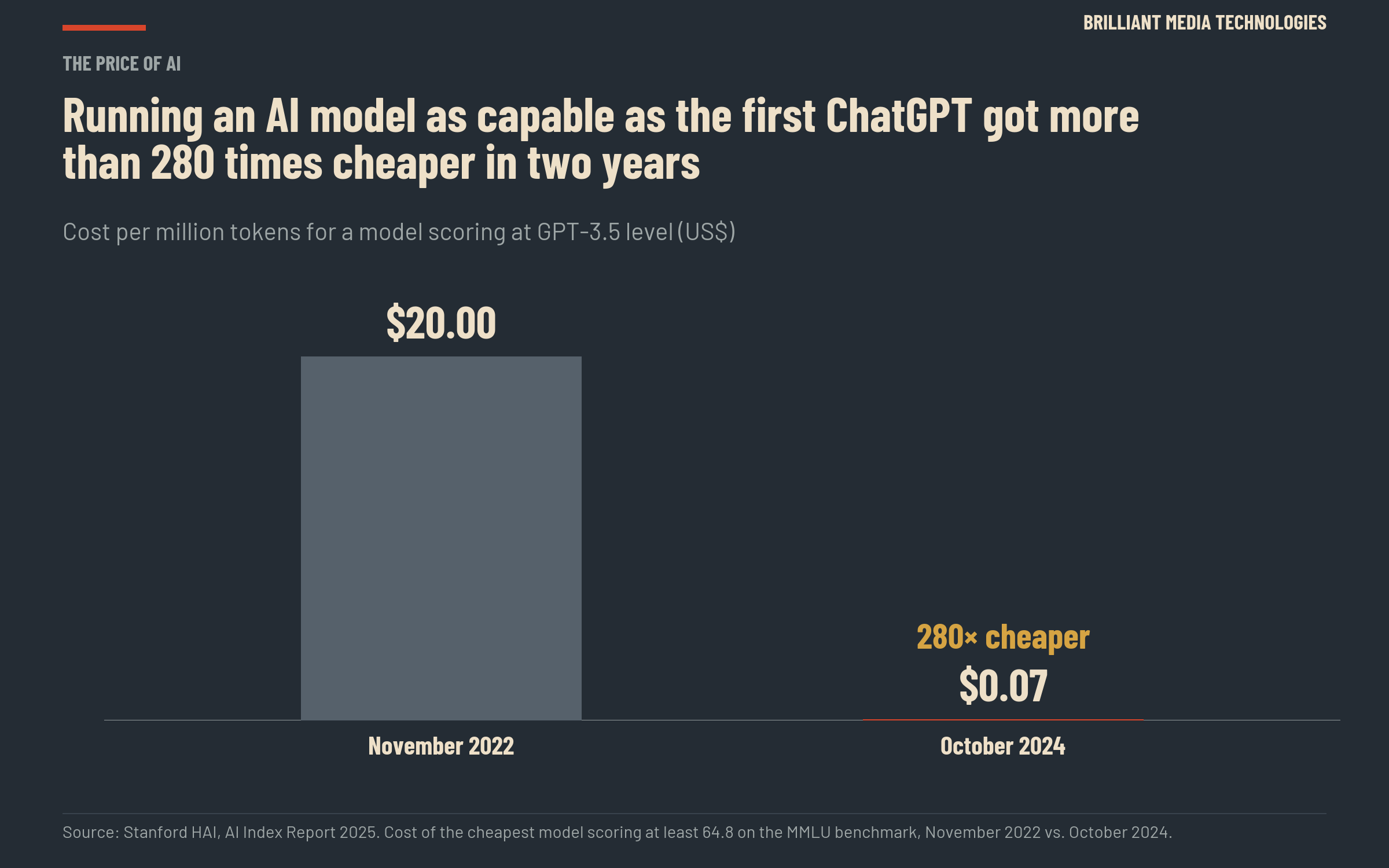
- It's cheap. The capability that cost thousands of dollars in custom software a few years ago now costs a monthly subscription. The cost of running a model as capable as the first ChatGPT fell more than 280-fold in two years, and it keeps falling.
- It's fast. A useful deployment takes weeks, not years. The payback period is measured in months.
- It has no minimum size. The same tools that help a bank's analysts help a four-person accounting practice, a regional distributor or a clinic.
That last point matters most for Canada. Our productivity problem isn't concentrated in a few big companies. It's spread across hundreds of thousands of small and mid-sized firms that could never justify the traditional kind of capital. For the first time, the most powerful productivity tool available is also one of the most accessible.
What the evidence actually shows
There's no shortage of hype about AI, so let's stick to controlled studies of real workers doing real jobs.
The most cited is by Erik Brynjolfsson, Danielle Li and Lindsey Raymond, published in the Quarterly Journal of Economics. They tracked more than 5,000 customer-support agents as a company rolled out a generative AI assistant. Productivity, measured as issues resolved per hour, rose about 15% on average. The biggest gains went to less experienced and lower-skilled workers, who improved in both speed and quality.
In other words, the tool spread the know-how of the best employees to everyone else. The earlier version of the study also found happier customers and higher employee retention.
A second study, run by researchers from Harvard, Wharton and MIT with Boston Consulting Group, randomly gave 758 consultants access to GPT-4. On realistic tasks within the AI's capabilities, those using it completed 12.2% more tasks, worked about 25% faster and produced work rated about 40% higher in quality.
That same study also contains the most important warning in this whole debate. On a task deliberately chosen to sit outside the AI's capabilities, consultants using it were 19 percentage points less likely to get the right answer than those working without it. Same tool, opposite result. The difference was knowing where it helps and where it doesn't.
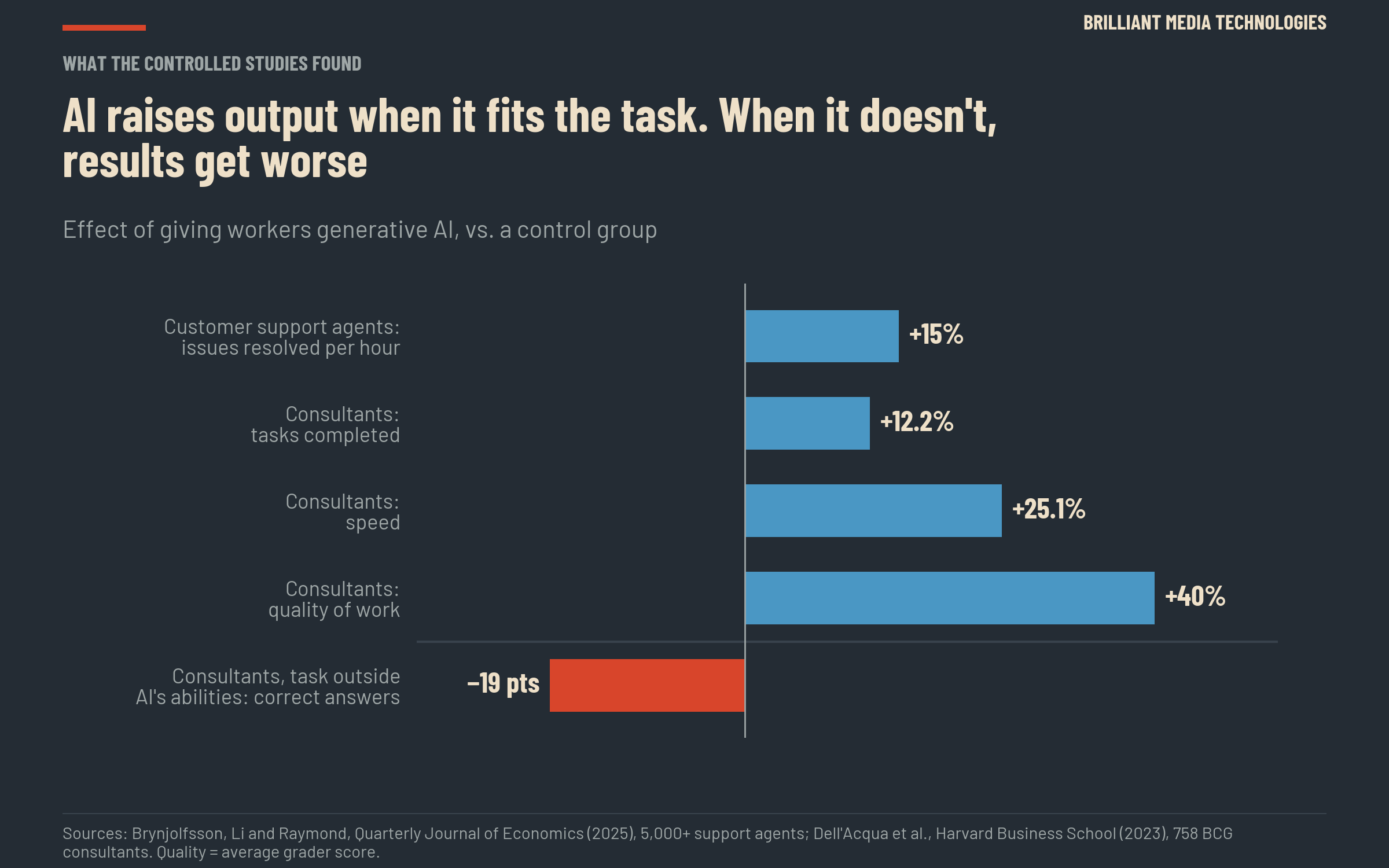
That's the pattern in almost every serious study. AI raises output per worker substantially, but only when it's applied to the right tasks, by people who understand its limits. That makes the gains real but not automatic, which is exactly why adoption, not invention, is where Canada wins or loses.
Abundance, not austerity
Here's where much of corporate Canada is about to get this wrong.
Ask most executives what AI is for and the honest answer is cost cutting. The Bank of Canada's survey of business leaders found that, looking three years out, 23% of firms expect AI to reduce their employment and only 11% expect it to increase. Larger firms are more likely to expect cuts. The Bank's researchers also see early signs that AI may already be influencing hiring for the jobs most exposed to it.
I understand the instinct. Headcount is the biggest line on most income statements, and cutting it shows up in the next quarter. But as a strategy for a company, and especially for a country, it's the small idea.
When a firm uses AI to produce the same output with fewer employees, its own productivity rises. But the country's output hasn't grown. The people let go produce nothing until they find new work, and in a soft labour market that can take a long time. The numerator stays flat. Nobody is richer, on average, and some people are much poorer.
Now take the other path. A firm keeps its team and uses AI to serve more customers, enter new markets, launch products it couldn't staff before, or do higher-quality work at the same price. Output rises with the same number of people. That's the numerator moving, and that's exactly what Canada has failed to do for a decade.
The business case points the same way. A cost cut is a one-time gain with a floor: you can only cut so far. Growth compounds. The company that uses AI to shed ten people ends up with a smaller team competing against rivals who used the same tools to do twice as much with the people they had.
I learned this before AI was part of the conversation. At Daily Hive, the media company I co-founded, we built automatic reporting for our advertising clients. When a campaign ended, the client received a report from their sales rep, pulled straight from Google Analytics and the social media platforms through their APIs. Nobody had to copy numbers into a spreadsheet anymore, and nobody had to worry about a typo in a client report.
The obvious move would have been to run the department with fewer account managers. Instead, we used the time they got back to write a human summary on top of every report. That better service created more upsell opportunities, the upsells turned into more sales, and the department grew along with the company.
The automation was cheap. What made it pay was the decision about what to do with the time it freed up.
The research supports this. In the customer-support study, the largest gains went to newer and less experienced workers, and employee retention improved. The technology didn't make people redundant. It made average workers better and helped new hires get good faster.
For an economy that just absorbed millions of newcomers, many still finding their footing, that's precisely the kind of productivity tool we need.
None of this means no job will change. Some roles will shrink, and pretending otherwise would be dishonest. But the answer is to redeploy people toward growth, not to treat the most powerful productivity technology in a generation as a layoff tool. Abundance isn't a slogan. It's arithmetic.
Canada doesn't have an access problem. It has a depth problem.
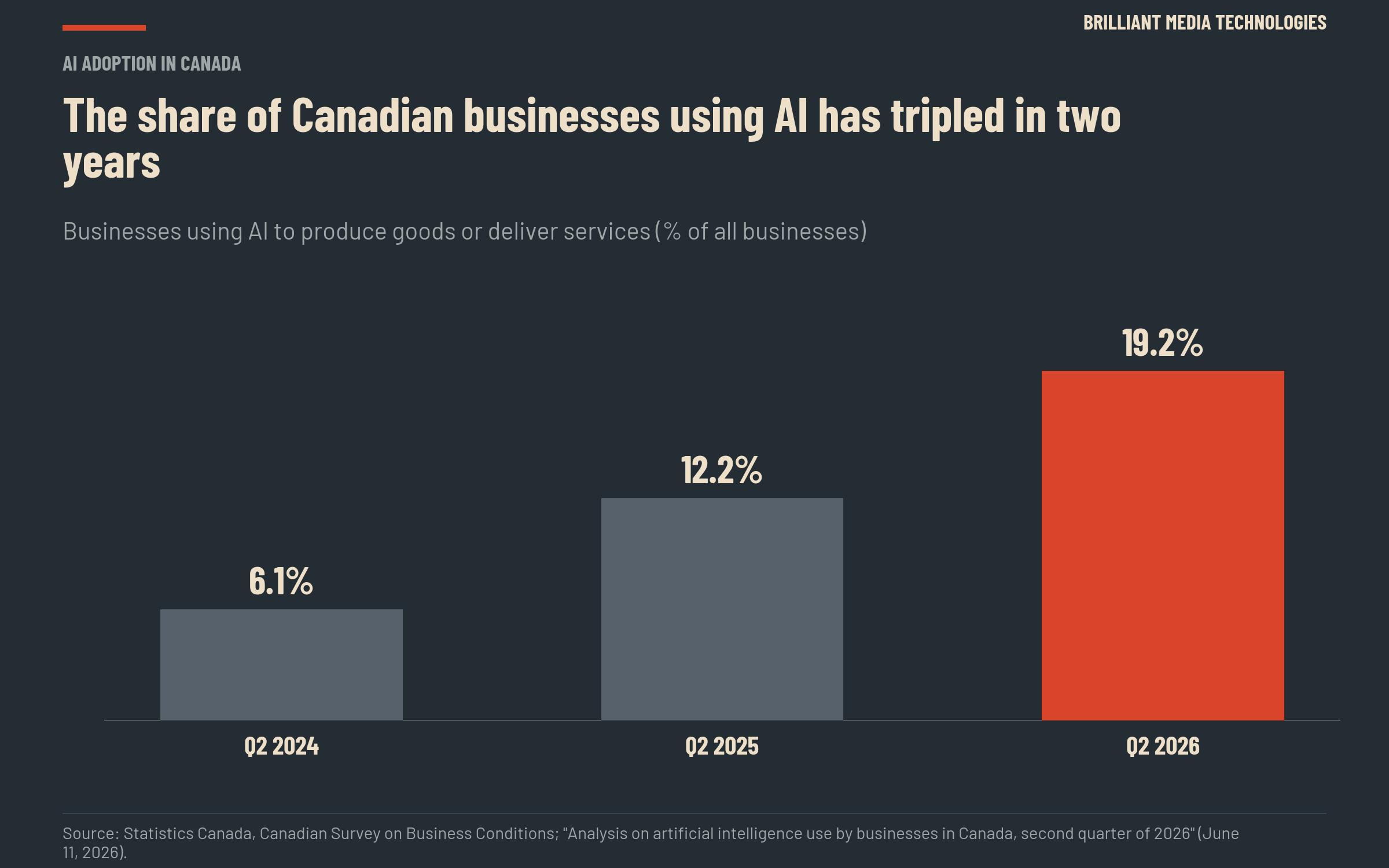
The good news first. Canadian businesses are picking up AI quickly. In the second quarter of 2026, 19.2% of businesses reported using AI to produce goods or deliver services, up from 12.2% a year earlier and 6.1% two years earlier. By one comparison, that puts Canada roughly level with the United States on adoption, although the American survey now asks a broader question, so the match is rough.
Now the problem. Using AI and building a business around it are different things. More than two-thirds of Canadian business leaders personally use AI tools in a typical week. Yet only 8% of businesses say they use it significantly in their core operations.
Leaders are experimenting at their desks. Their companies haven't changed how they work. That's why adoption numbers are rising while productivity isn't.
The gap is widest exactly where Canada's productivity problem is deepest.
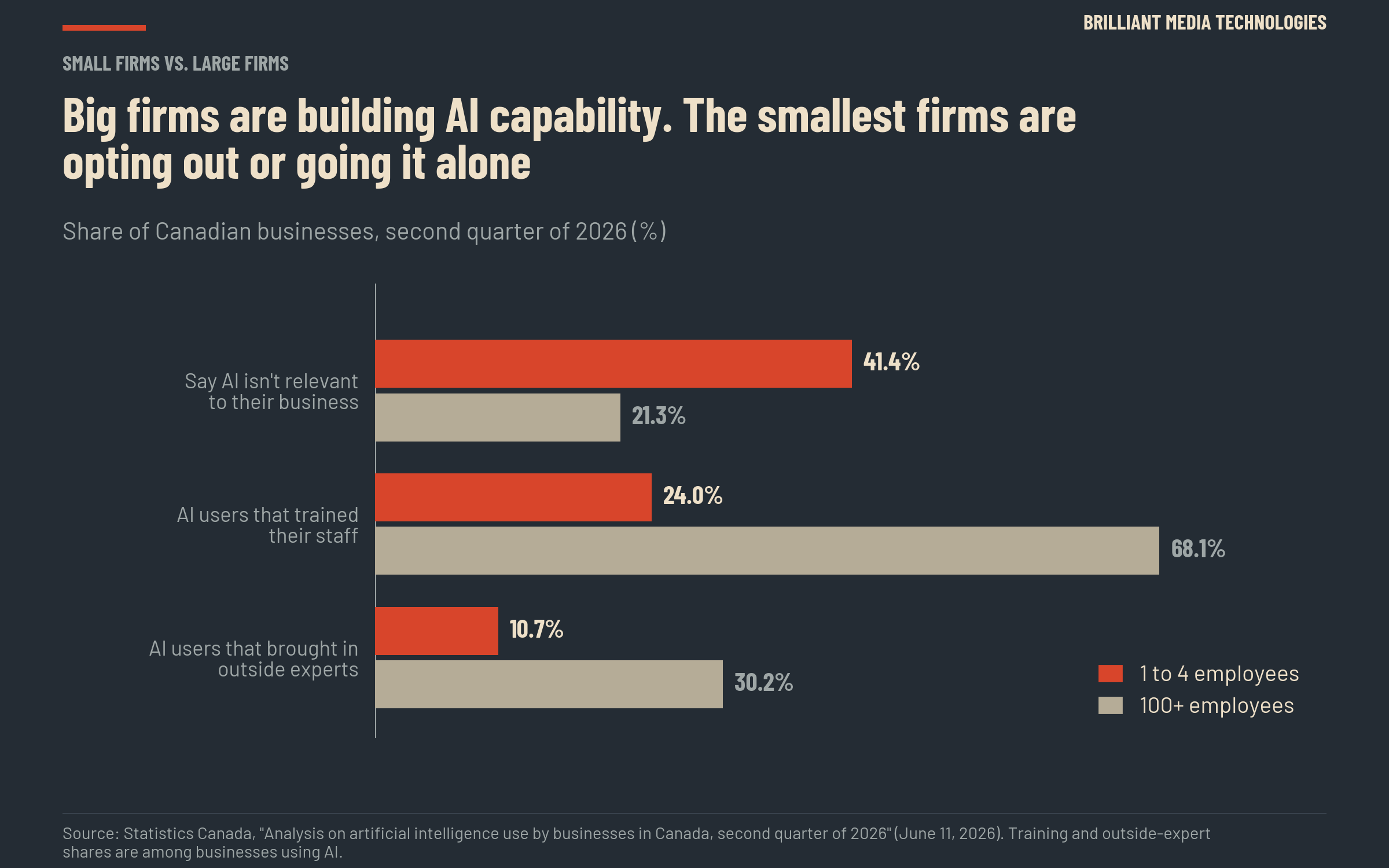
- Small firms are opting out. Among businesses with one to four employees, 41.4% say AI simply isn't relevant to them, about twice the rate of firms with 100 or more employees.
- Small firms go it alone. Among AI-using businesses with 100 or more employees, 68.1% trained their staff and 30.2% brought in outside consultants or vendors. Among the smallest AI users, those figures were 24.0% and 10.7%. Big firms treat AI as a capability to build. Small firms treat it as a subscription to try.
- Traditional industries are barely started. Adoption was 4.5% in agriculture, forestry and fishing, 7.9% in wholesale trade and 9.2% in construction. In information and cultural industries, it was 42.3%.
- Half the country isn't planning to start. In the third quarter of 2026, 52.7% of businesses said they had no plans to use AI in the next year. Of those, 79.1% said it wasn't relevant to what they do.
That last number deserves pushback. Every wholesaler has quotes, invoices, inventory and customer emails. Every construction firm has estimates, scheduling, permits and change orders. "Not relevant" isn't an assessment. For most firms, it's an assumption nobody has tested.
In our work with small and mid-sized Canadian businesses, the obstacles we see most are not technical. There's no one inside the company who owns the project. No one measured how long the work took before, so no one can prove it got better. And a promising pilot never makes it into daily operations because nobody redesigned the workflow around it. These are management problems, and they're solvable, but not by buying a subscription and hoping.
Own it, don't just rent it
There's one more way Canada could waste this opportunity, and it's subtler than not adopting at all.
The top barrier Canadian businesses cite to using AI isn't cost. It's cybersecurity and privacy, named by 13.4% of all businesses and by 30% of firms with 100 or more employees. In health care and in information and cultural industries, more than a quarter of businesses cite it.
Those firms are right to worry. A company that pipes its customer records, contracts and financials into a foreign service is betting on where that data goes and which laws apply to it. Capable open-weight models can now run on infrastructure a company controls, in Canada, under Canadian law. That turns AI from a service you rent into an asset you own. I’ll come back to data sovereignty in a future piece.
Three asks
Diagnosis is cheap. Here's what I think each of us should actually do.
To policymakers: stop funding invention and start funding adoption. Canada already produces world-class AI research. What it doesn't do is help a 15-person distributor in Winnipeg put that research to work. The new productivity mega deduction is a strong signal, and it already covers software. But for a small firm, the real cost of AI isn't the licence. It's implementation and training. Make sure the incentives reach those, and put real money into helping small firms adopt, not just into labs and research grants.
To business owners: pick one workflow this quarter. Measure how long it takes today. Put one person in charge of improving it with AI, and give them the time to do it properly. When it works, use the capacity you've freed to grow: more customers, faster turnaround, a new service. Don't use it to cut the people who made it work. Your competitors will be making the same choice, and the ones who grow will win.
To ourselves at Brilliant Media Technologies: we'll publish what we learn from real implementations with Canadian businesses, including the numbers before and after and the projects that didn't work. We'll judge our work by whether our clients produce more per person, not by how many jobs they cut. If we're going to argue that this is how Canada raises its living standards, we should be held to showing it.
The choice
For the past decade, Canada made labour cheap and capital expensive, and our businesses took the deal. Living standards paid for it.
This decade, something unusual has happened: the capital itself got cheap. The most important productivity technology in a generation costs a fraction of a new hire, deploys in weeks and works as well for a small firm as a large one. It lands in exactly the category of investment where Canada fell furthest behind.
We can use it the way we used cheap labour, to avoid hard changes and trim costs at the margin. Or we can use it to do something this country hasn't done in ten years: make each Canadian's work worth more than it was the year before.
That's the whole productivity debate, reduced to one decision made in thousands of businesses. In the next series, I'll show what it looks like in practice, with case studies from Canadian small and mid-sized businesses that made it.
Sources
- Grady Munro, Jake Fuss and Joel Emes, Squandering the Canadian Century Part 1, Fraser Institute, September 2026.
- Stanford Institute for Human-Centered AI, AI Index Report 2025, April 2025.
- Erik Brynjolfsson, Danielle Li and Lindsey Raymond, "Generative AI at Work", Quarterly Journal of Economics 140(2), May 2025.
- Erik Brynjolfsson, Danielle Li and Lindsey Raymond, "Generative AI at Work", NBER Working Paper 31161, 2023.
- Fabrizio Dell'Acqua et al., "Navigating the Jagged Technological Frontier", Harvard Business School Working Paper 24-013, 2023.
- Chanya Chawla and Crystal Arnburg, "Canadian businesses' use of AI: What the evidence shows", Bank of Canada, August 2026.
- Statistics Canada, "Analysis on artificial intelligence use by businesses in Canada, second quarter of 2026", June 11, 2026.
- The Hub, "Canadian businesses are closing the AI adoption gap with U.S. counterparts, but productivity gap remains", June 26, 2026.
- Statistics Canada, "Canadian Survey on Business Conditions, third quarter 2026", The Daily, August 31, 2026.
- Prime Minister's Office, "Prime Minister Carney introduces new Productivity Mega Deduction", September 15, 2026.